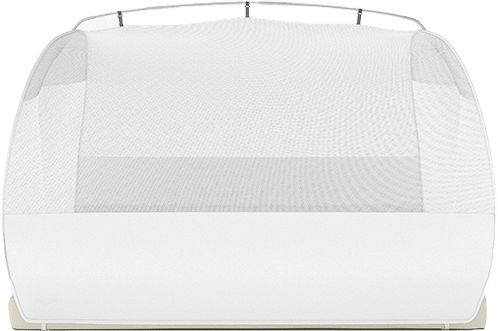
Comparison of traditional mosquito nets versus OKnet design showing improved safety and usability

The Difference Between Traditional Mosquito Nets & OKnet

Traditional bednets require perfect use. OKnet is built for real-world use. A breakthrough redesign sharply increases adoption — directly translating into more lives saved.

OKnet

OKnet

Current Hanging Net

Current Hanging Net

Easy.

  • One-person setup: even a youngster
  • Self-erects: eliminates training
  • When unpacking, even 1st-time users clearly recognize the final shape
  • End panels self-open, poles self-connect and user just attaches the pole to the panels
  • Self-standing design allows for trouble-free repositioning

Difficult.

  • Several adults are required for setup
  • Requires expensive training
  • When unpacking, even trained users can't recognize the final shape
  • Users hammer nails into walls or ceiling, tie strings to the mesh fabric, attach them and adjust tension
  • Repositioning is difficult because of the nails and strings

Safe.

  • Protected: stand-alone frame keeps mesh fabric tight and away from skin
  • Sealed: tensioned mesh fabric encloses and seals in users. Secures tightly to the mattress or pad
  • Two ergonomic full-length doors for easy entry and exit
  • Spring-assisted snap-shut doors keep mosquitoes out
  • Durable: flexible end panels provide structural integrity, spread tension to prevent mesh tears

Dangerous.

  • Exposed: mosquitoes bite through when skin contacts the loose mesh fabric
  • Open: users must tuck loose mesh fabric under the mattress or pad, which is difficult from the inside
  • No doors: users lift tucked-under mesh to get in and out, lifting the mesh fabric lets mosquitoes in
  • Spring-assisted snap-shut doors keep mosquitoes out
  • Fragile: structural failure occurs when user movements snap a string or tear the mesh fabric

Simple.

  • Self-standing and only 2 lbs. so you can pick up and move anywhere
  • Stronger design keeps working despite wear and tear
  • Quick, 1-person disassembly: Remove and fold the pole, stack the end panels
  • Easy storage: stacks in a flat 2-inch disk and fits almost anywhere
  • In the field: anchors securely with no extra parts

Impractical.

  • Can't be moved once installed, since it’s tied to walls by strings
  • Unusable if any string or the mesh fabric is damaged
  • Complex disassembly: Unhook multiple strings, fold the mesh fabric and try to pack it
  • If not disassembled, it occupies space most homes cannot spare
  • In the field: unstable even with additional supports

Efficient.

  • Design can't be adapted beyond its intended use
  • Cuts mesh fabric use in half, saving cost and bulk
  • Adjustable design adapts to multiple sizes
  • Nets per life saved = 50-100
  • Cost per life saved = $200

Wasteful.

  • Mesh fabric can be repurposed for other uses
  • Uses more mesh fabric, which adds cost and weight
  • Rigid design restricts both shape and size
  • Nets per life saved > 500-1,000
  • Cost per life saved = $4,500

Does This Make Any Sense at All? Read the Independent 3rd Party Review.

EASY. SAFE. SIMPLE. EASY. SAFE. SIMPLE.
drag icon
360 view