Climate Change and Malaria: Is the Panic Justified?
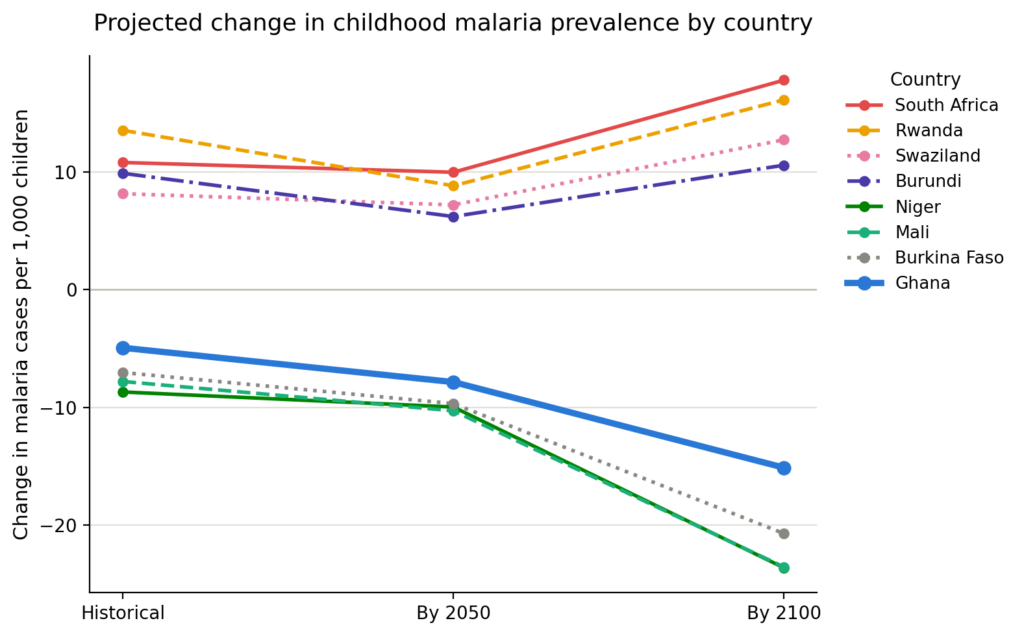
Climate change: Not more malaria, just a redrawn map
Most headlines make it sound like climate change will spread malaria across the world. Whether or not you buy into the broader climate debate, it's worth seeing the full picture on this one.
Malaria is moving, not increasing
First of all, climate change is shifting malaria risk across Africa — not increasing it.
In cooler areas — including eastern and southern Africa — rising temperatures are creating more favorable conditions for mosquitoes and the malaria parasite. These areas are vulnerable, since they have limited immunity and lack well-established malaria-control systems.
But in hotter regions — including west and central Africa — the opposite happens. Temperatures above 25°C shorten mosquito lifespan and disrupt the parasite’s development. So in these areas, rising temperatures actually reduce transmission.
There is no mosquito apocalypse
Researchers projected historical climate conditions against simulations (including human-caused warming) by analyzing 50,000+ historical malaria observations.
The future projections are far too small to justify hysteria. In the worst-affected countries, models project 10 additional infections per 1,000 children by 2050 — 25 years from now — or 18 by 2100 — 75 years from now. That’s 1% and 1.8%, respectively.
Elsewhere, the trend reverses: 10 fewer infections per 1,000 children by 2050 and 24 fewer by 2100. That’s 1% and 2.4%, respectively.
Taken together, the projections show malaria risk is shifting — but not exploding across Africa. New hotspots emerge in cooler regions, but they are outweighed by projected declines in West and Central Africa, where temperatures are already high and much of the continent’s current malaria burden is concentrated.
The researchers themselves said it this way:
"Warming creates new hotspots; however, warming produces a larger net African decline, mainly because West and Central Africa currently contain much of the malaria burden."
It’s not the heat — it’s the havoc
Droughts, which are linked to lower malaria rates, and floods, which create mosquito-breeding sites, are both climate-related. However, the wider effects of extreme weather — displacement, disrupted access to bed nets and healthcare — matter more than the direct effects of changing temperatures.
Climate gets headlines, malaria control gets results
Climate isn't the main force shaping malaria rates. Public-health measures — mosquito nets, testing, treatment, vector control, and improved housing — deliver far bigger gains. The decline in malaria from malaria-control programs since 2000 is estimated to be about 200 times larger than the man-made effects of warming.
The full picture
The mainstream media keeps hyping the mosquito fear-mongering campaign. Here's a typical example, from Germany: https://youtu.be/CHVjUo2yXn0?si=kZlIXaNtQaALzmzJ
But the key takeaway, the actual fact, is that the mosquitoes' burden is moving, not growing. As the researchers themselves say,
“Climate change is a modest factor next to the impact of malaria control efforts: bed nets, treatment access, vaccines, and vector control have historically reduced malaria far more than climate change has increased or decreased it.”
Source: https://www.japantimes.co.jp/environment/2026/08/04/climate-change/climate-change-africa-malaria-map/