The Tiny Warriors That Won American Independence
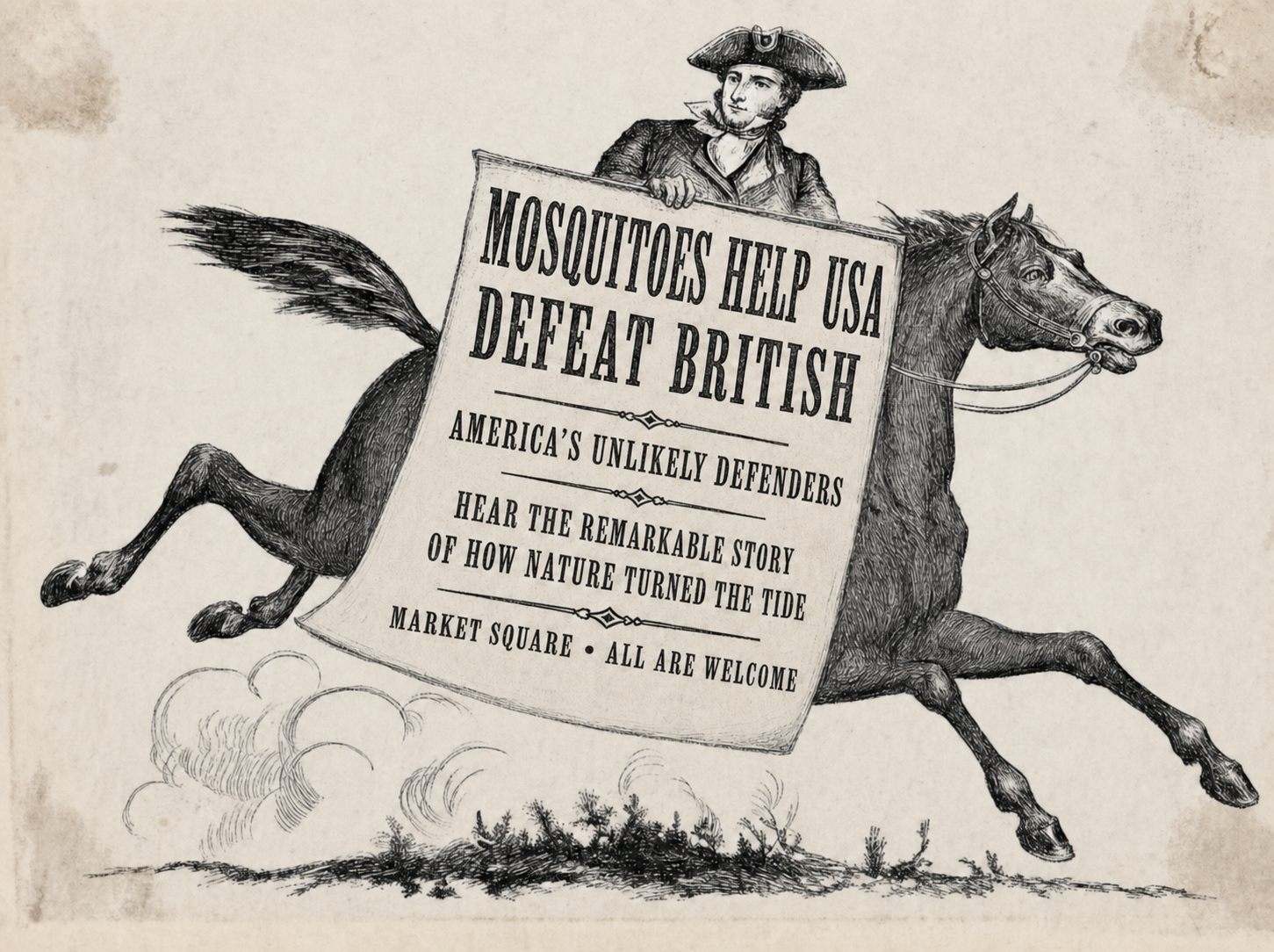
Mosquitoes help defeat the British
How did Mosquitoes defeat the British in the Revolutionary War, and give America its Independence??
The Revolutionary War reached a stalemate in the north and so British leaders shifted their main effort to the Carolinas and Virginia, believing that Loyalist support would be stronger there. It was called the “Southern strategy.”
The plan brought thousands of British and German soldiers into one of the most malarial regions of North America. That geography mattered as much as any battle plan.
In the Carolinas, the Americans avoided all-or-nothing confrontations with the superior British forces. Instead, they retreated, regrouped and forced British troops to pursue them across difficult country.
An Invisible Enemy
The British forces were from parts of Europe where malaria and yellow fever were uncommon. They had little previous exposure to the disease and no acquired resistance.
Their American opponents had an advantage. Soldiers raised in disease-prone areas of the South had survived earlier infections, and repeated exposure reduced the severity. In the language of the period, they were “seasoned” -- partially immune and able to keep fighting through a fever that flattened everyone else. This gave the Americans a weapon they didn't have to fire. Malaria and yellow fever attacked every army—but it did not attack every soldier equally. This advantage should not be overstated.
The American strategy of avoiding major confrontations wore down the British army as frequent skirmishes, long marches and sickness worked together.
By August 1781, General Cornwallis fortified Yorktown, a deep-water port on the Chesapeake. It was a secure anchorage where the Royal Navy could shelter large warships and where fresh troops could be shipped in or out by sea as needed.
Yorktown’s access to the sea was vital for naval support, but the location also placed the British forces near low marshes and standing water in late summer—the prime of the mosquito season.
The plan called for the Yorktown naval station to keep the army mobile and resupplied by water. But the catch -- and the tragedy for Cornwallis -- is that the entire concept rested on one assumption: that Britain would always control the sea. A deep-water port was a lifeline only as long as The Royal Navy owned the water.
The French fleet arrived from the Caribbean in early September 1781. After winning the Battle of the Chesapeake, they sealed off Chesapeake Bay. Immediately Yorktown was flipped from a naval base into a trap. Cornwallis was pinned against the water with no escape by sea and a combined French-American army closing in by land.
The Smallest Force on the Battlefield
George Washington marched south and laid siege. He arrived in late September, so the mosquitoes had only a few weeks to infect the American and French forces before the siege ended, about three weeks later. Trapped inside their defenses, Cornwallis's men endured relentless artillery fire as mosquito-borne disease, dysentery, and exhaustion swept through his army. By the eve of the surrender, well over half were too sick or wounded to fight. On October 19, 1781, Cornwallis surrendered.
Yorktown was the last major campaign in the Revolutionary War. Nearly 8,000 British and German troops were captured — about one-third of all British forces in North America. Although Britain still held New York, Charleston and Savannah, its strongest army in the South had been destroyed.
The French naval blockade proved that Britain could no longer rely on control of the sea to supply or rescue its armies. Meanwhile in Britain, the defeat at Yorktown shattered political support for continuing the war. Rebuilding another army and conquering the Colonies had become politically and financially unrealistic.
The American Revolution was won not only with strategy and muskets, but with immunity. In the Southern marshes, another force had entered the war: the mosquito. Through malaria and yellow fever, mosquitoes fought on the American side.
Mosquitoes do not need to fire a weapon to change history.
From: The Mosquito: A Human History of Our Deadliest Predator, by historian Timothy C. Winegard.